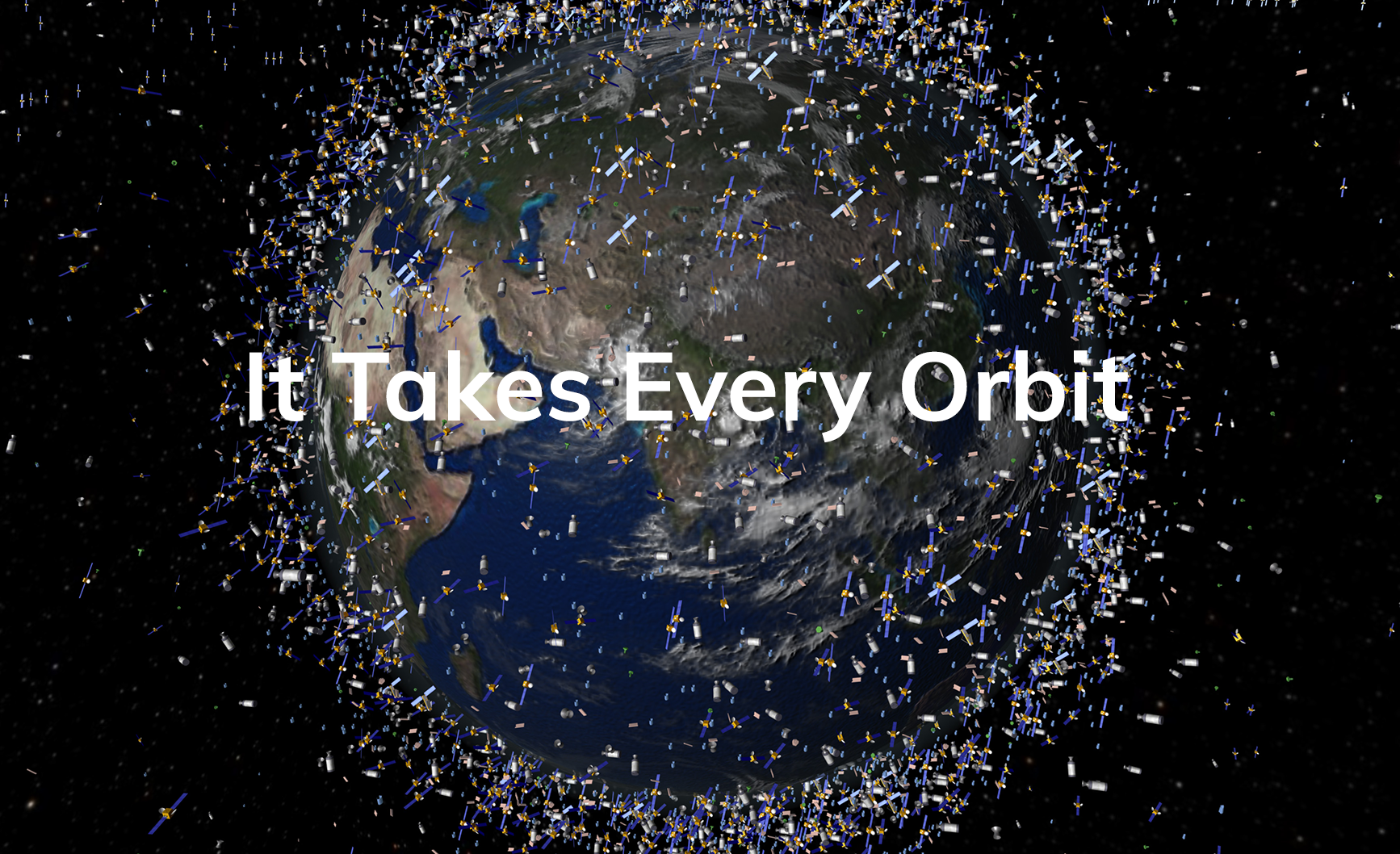
As the number of active spacecraft and debris objects in Earth orbit grows, identifying potentially hazardous close approaches is becoming more demanding. This is not solely a low Earth orbit (LEO) concern: operators in medium Earth orbit (MEO) and geostationary Earth orbit (GEO) also need reliable assessments and effective means of coordinating their activities. No system can eliminate collision risk, but timely information and sound operational decisions can help reduce it.
Space situational awareness (SSA) involves observing, tracking and characterising space objects and estimating their future trajectories, together with the uncertainty in those estimates. Conjunction assessment uses this information to identify predicted close approaches and evaluate their risks. Space traffic coordination (STC) adds a distinct human and operational dimension: exchanging relevant information, contacting other operators and, when necessary, coordinating potential collision-avoidance actions. Assessments support operators’ decisions; they do not themselves direct spacecraft.
Cooperation and interoperability
Effective conjunction assessment draws on multiple, complementary sources: radar and optical observations; government catalogues and orbital products, including Special Perturbations (SP) data where available; and spacecraft operators’ own ephemerides, spacecraft characteristics and planned manoeuvres. Independent observations are essential for debris and other objects that do not provide operational data. Operator information, in turn, can provide more timely trajectories and insight into intended manoeuvres. Current, well-characterised data from both are needed for reliable risk assessments.
No single source or service offers a complete picture of the orbital environment. Differences in observations, orbit estimates, covariance assumptions and alert thresholds can also lead services to produce different assessments of the same close approach. Such differences are not necessarily errors, but they complicate operational decisions. Transparent methodologies, compatible data formats and timely exchange of information can help operators interpret warnings and respond appropriately.
Just as importantly, when two active spacecraft may approach one another, the ability to reach the other operator and coordinate a response may matter as much as the underlying calculations. Space safety therefore depends on cooperation among operators and interoperability among government, commercial and operator-supported services—not on expecting any one platform to do everything.
A growing SSA ecosystem
Publicly supported SSA capabilities are expanding. EU Space Surveillance and Tracking (EU SST), a partnership of 19 EU Member States working with the EU Agency for the Space Programme, provides operational collision-avoidance, re-entry and fragmentation-analysis services. The U.S. Traffic Coordination System for Space (TraCSS) is being developed by NOAA’s Office of Space Commerce to provide baseline SSA data and spaceflight-safety services to civil and private operators. TraCSS remains in pilot evaluation while its production capabilities and schedule are developed.
In the commercial sector, SpaceX has expanded its existing Starlink Space Safety service with Stargaze, an optical observation capability using star trackers aboard Starlink satellites. The service offers participating operators ephemeris sharing and rapid conjunction screening, with Stargaze observations providing an additional source of data. Other commercial providers contribute specialised sensors, catalogues and analytical services. These developments give operators valuable additional capabilities rather than a single universal solution.
The importance of cross-system cooperation is already evident. An October 2026 joint study by EU SST and TraCSSexamined how their conjunction products differ and how operational information exchange can improve consistency and usefulness. Its lessons point toward a more connected SSA ecosystem in which diverse providers share relevant information and operators can act on assessments with greater confidence.
What the Space Data Association adds
Founded in 2009, the Space Data Association (SDA) is an independent, nonprofit, operator-governed association created to improve spaceflight safety through cooperation among satellite operators. Its contribution is institutional as well as technical. SDA provides a standing forum in which operators—including commercial competitors—can build trusted working relationships, address shared flight-safety challenges and advance practical operational practices. This function matters independently of any particular surveillance or collision-screening system.
For example, SDA’s June 2026 workshop in Vienna brought operators and other space-safety stakeholders together to discuss practical approaches to coordination and sustainability. Such engagement complements the routine, often time-critical exchange of operational information needed when spacecraft may encounter one another.
SDA also offers a trusted framework for sharing information that may be operationally or commercially sensitive. Participating operators contribute orbital information, planned manoeuvre data and designated points of contact under binding arrangements specifying permitted uses and restrictions on onward disclosure. The framework supports necessary safety-of-flight coordination while respecting legitimate confidentiality and security concerns. In this way, SDA helps address an obstacle that software alone cannot solve: enabling organisations with different interests to cooperate on shared operational risks.
One example of the value provided by the SDA involved a satellite undergoing re-orbiting while another was being relocated to a new orbital position. When the planned drift-stop manoeuvres for the relocating satellite were incorporated into the conjunction assessment, a potential close approach between the two spacecraft was identified. By enabling the sharing of ephemeris including manoeuvre information and fostering operator coordination, the SDA helped improve situational awareness and support the safe execution of both operations. This example illustrates how collaboration through the SDA can reduce operational risk and enhance the safety of satellite operations.
SDA’s Space Safety Portal (SSP) translates that cooperation into practical services. Operated by GMV, the SSP brings together participating operators’ flight-dynamics information with public catalogue and other available third-party data to support conjunction screening, risk assessment and timely warnings. Its published capabilities include enhanced screening using SP products, synthetic covariance estimates to help characterise orbital uncertainty where appropriate, additional data inputs and secure interfaces for exchanging operator information.
These elements reinforce one another. More timely operator information can make assessments more actionable; clear rules for handling that information encourage participation; and established channels of communication help operators coordinate their responses. SDA therefore complements governmental and commercial SSA capabilities rather than seeking to replace them.
Calling operators from every orbit
Spaceflight safety is a shared responsibility across LEO, MEO and GEO, even though the hazards, operating practices and data needs differ by orbital regime. Operators of established fleets, emerging constellations and mixed-orbit networks all benefit from reliable information, trusted contacts and practical coordination arrangements. Broader participation makes those arrangements more useful to the space community as a whole.
SDA invites operators across these orbital regimes to take part: to contribute timely operational information under its established safeguards, use the SSP’s flight-safety services, and help shape the cooperative practices on which sustainable space operations depend. The objective is not to centralise every space-safety activity, but to connect people, information and capabilities so that operators can make better-informed decisions.
To learn more about the Space Data Association, participation and the Space Safety Portal, get in touch.